

Louis Stuber AG: We sort the world
Anyone who wants to succeed in today's control and plant engineering industry needs more than just experience and technical skills. Digitalisation, end-to-end data, and efficient processes determine whether projects can be implemented cost-effectively. Louis Stuber AG, based in the Swiss canton of Bern, has recognised this shift and has taken decisive action to implement it. Together with Eplan and Rittal, they developed a new approach to control system design step by step.
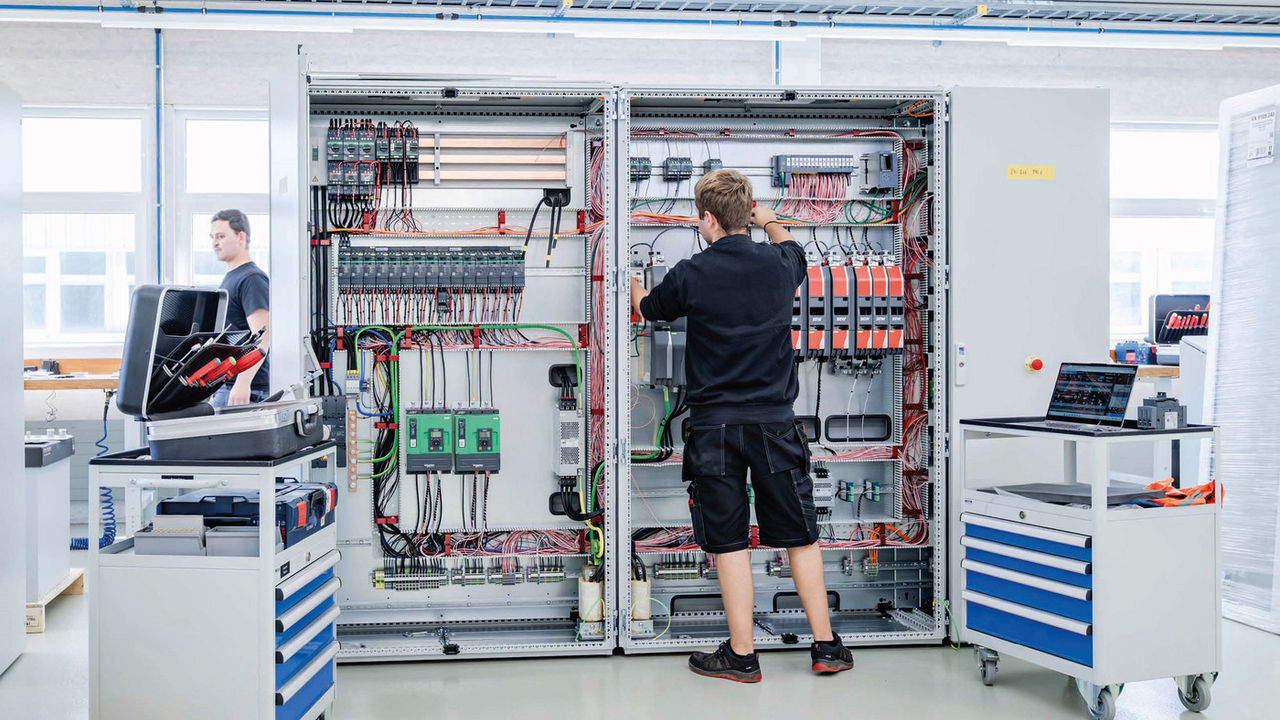
Anyone who works in Switzerland in the fields of recycling, intralogistics, agriculture, water, stone or soil is familiar with what this automation partner offers for industrial sorting processes. “We sort the world, so to speak,” says Christian Bütikofer, owner and managing director of the company founded in 1920, summing up the scope of the operations of his electrical company. "We give our customers everything they need from a single source. This starts with engineering, moves on to creating electrical drawings and programming control systems, and ends with assembling control cabinets of all sizes, from very small to very large. "We also offer installation and commissioning," Bütikofer explains in more detail.
This often involves custom systems or the construction of prototype control cabinets “We are particularly motivated by challenging tasks that call for customised solutions,” the owner notes. To ensure this can remain successful in the future, the step toward automation and digitisation was necessary. "We've always tried to improve the efficiency of our processes, but such processes are only possible through digitisation and automation— Even though it's not easy to let go of the old," recalls the team at Louis Stuber AG. This was made possible with the help of Davide Cannova, Account Manager at EPLAN Switzerland, and Mathias Taraca, Area Sales Manager at Rittal Switzerland. They took the concerns of Louis Stuber AG and supported the company in implementing the project.
Working efficiently
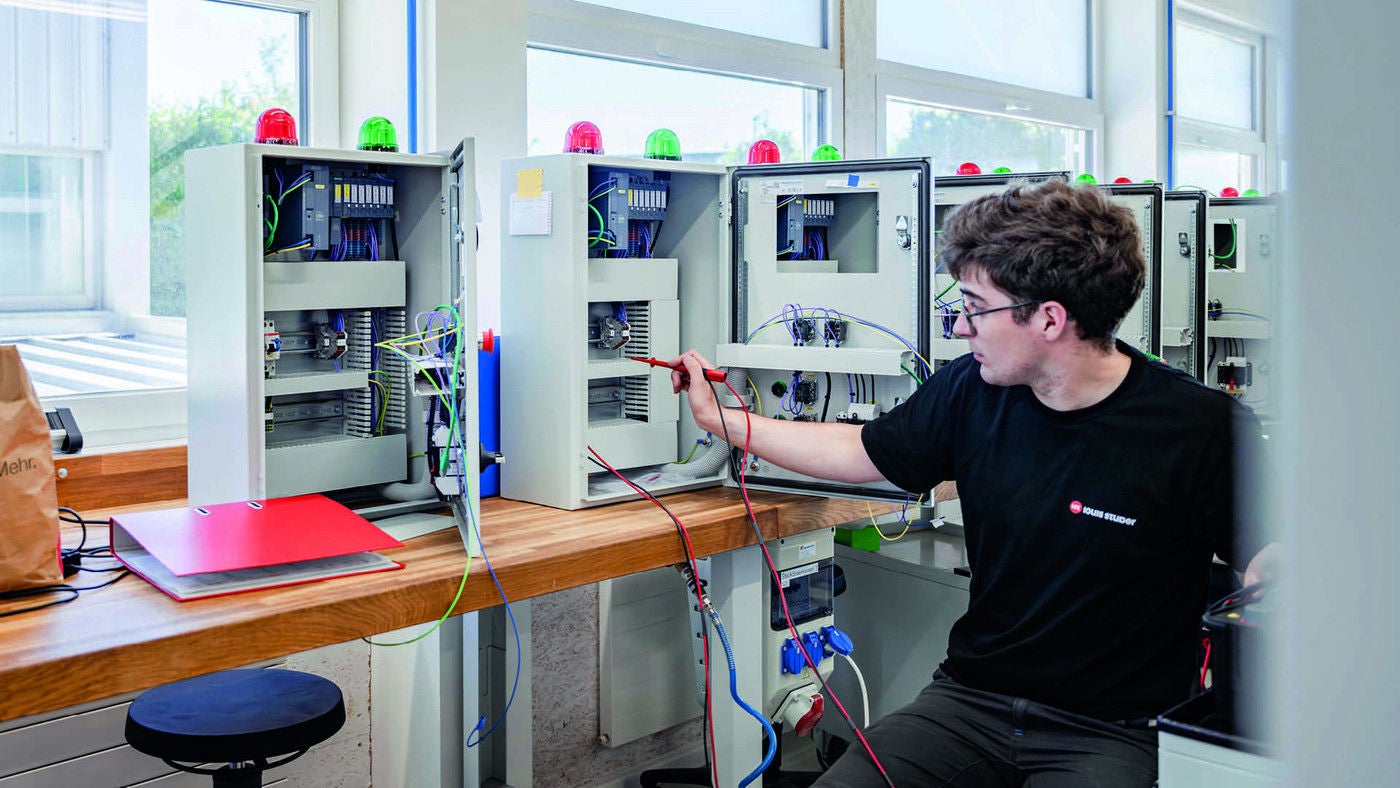
In the past, it took about eight to ten workdays to assemble a 4-meter control cabinet. “We used to spend a great deal of time on the traditional grid structure—even without making any changes,” recalls Roger Morgenthaler, Head of Industry & Control Systems. For a while, Rittal Switzerland used machining to speed up the production process for control cabinets. "We had to wait one or two weeks for the control cabinets to be returned to production. "Unfortunately, that took too much time during the process," explains Roger Morgenthaler.
That was ultimately what prompted Louis Stuber to purchase their own machining centre. In 2021, a Rittal Perforex was installed at their facility. This machine enables all the mechanical processing steps involved in the assembly of control cabinets to be completed in a single step—such as drilling, thread cutting, and milling cutouts. Louis Stuber selected a Perforex BC 1007 HS, which can clamp and machine flat parts up to 2450x1600 mm and cubic parts up to 1600x1400x1600 mm. It can also process all materials commonly used in control system manufacturing, such as steel, stainless steel, aluminium, copper, and even plastic.
Louis Stuber then moved on to address the topic of cutting wire ducts, cable channel covers, and mounting rails to length. Manual cutting with hand tools or a saw is tedious, time-consuming, and often not precise enough. In addition, deburring the cuts is a tedious process. "We used to do that the old-fashioned way with a saw until 2023. Then we purchased a Rittal Secarex AC 18," says Morgenthaler. It cuts channels, covers, and mounting rails to length, either semi-automatically or fully automatically. "Secarex could be described as a 'nice-to-have,' but according to our philosophy, it is an integral part of the entire process." Louis Stuber worked with these two machines for several years. "Then we thought about what else we could do—or rather, how we could develop further," says Bütikofer.
50% time savings
In 2017, the Institute for Control Engineering of Machine Tools and Manufacturing Equipment (ISW) at the University of Stuttgart conducted the “Control Cabinet Construction 4.0” study and found that 60% of production time is spent on wiring. According to the study, using pre-assembled wires or wire sets can save up to 50% of the time. "It was very interesting to hear how much potential there is for cost savings when wiring a control cabinet." That caught our attention. "After all, we know from our employees exactly how much time it takes to pick up a wire by hand, strip it properly, slip on the right sleeve, crimp it, put the tool back, and walk over to the right item," says Bütikofer, describing the tedious process of manual wire fabrication.
The Rittal Wire Terminal C10 fully automatic wire fabrication machine has been in use at Louis Stuber's production facility since 2024. It allows wires to be assembled ten times faster than by hand—including custom wire printing and order picking. Up to 36 different types of wire can be produced fully automatically without any manual intervention. This includes the processes of cutting to length, stripping, crimping, and project-specific labelling of the wires.
When asked whether the machines have caused employees to fear losing their jobs, Christian Bütikofer answers clearly: "Show me someone who actually says: 'Yes, that's my whole reason for living—stripping 100 wires a day, slipping on a conductor end sleeve, and crimping it.'" The reality is quite the opposite: When Bütikofer gives job applicants a tour of the facility, particularly the young people are very enthusiastic—especially those looking for an apprenticeship. “We’re already fully booked for this year, and we’ve already received applications for next year as well,” he says proudly.
Eplan opens a new world
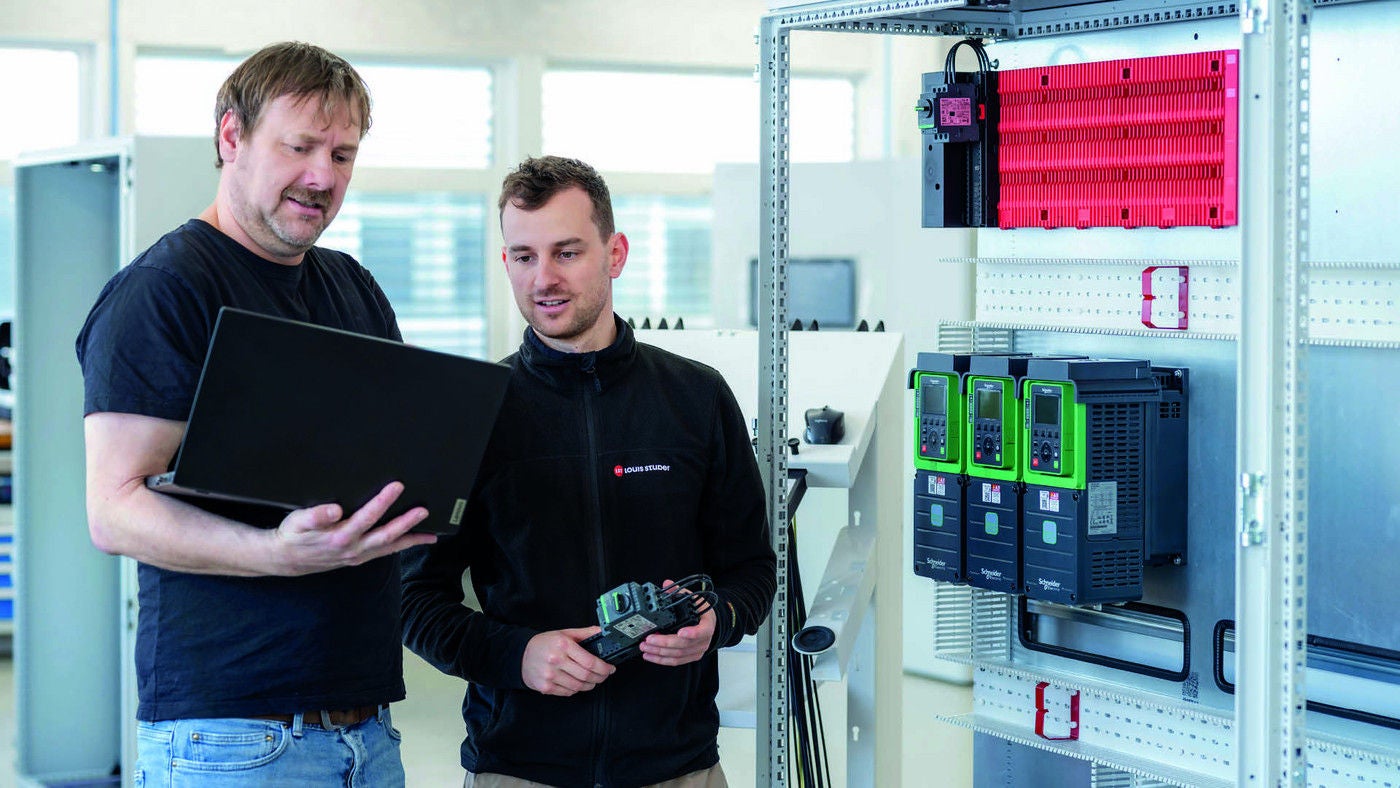
"Basically, it was Eplan that first opened up this world to us. "We spent quite a long time working on 2D control cabinet layouts," Morgenthaler reports. For the past few years, Louis Stuber has been using Eplan Cogineer, which makes it possible to create schematics with a single mouse click. "It automatically generates a scheme in Eplan Electric P8." Next, the 3D panel layout is modelled. "All data is transferred directly to the Rittal machines without any interruption," explains Davide Cannova. Finally, smart production helps employees do the assembly and wiring of the control cabinet.
This assistance system provides a view of the 3D‑model, including routing tracks and all relevant wire data, such as length, colour, cross-section, and connecting points. Nick Schwab, Head of Software Engineering at Louis Stuber, confirms: “The advantage is that we’ve created a seamless digital workflow with the help of Eplan and Rittal.” Another benefit is the reduction of sources of error, as these now occur only in engineering, not on the shop floor anymore. "If a wire is missing, it's not because someone forgot to take it off the spool or mark it off with a pencil because they had to jump from page 34 to page 240 in the paper diagram. If we've made a mistake, we can find it now. We've also drastically reduced the sources of error across the board," Schwab reports, drawing on his daily experience.
Another advantage of 3D planning is that it is easy to replicate projects or plan for retrofit installations. Thanks to the plant's digital twin, all the options can be viewed in advance—without having to stand in front of the control cabinet and check the available space. The system can even be presented to the customer during the planning phase. "You can see the number and arrangement of the components, which helps the customer visualise them better than a 2D drawing would. Plus, all of that costs money," Bütikofer chuckles.
The fact that Louis Stuber AG is currently one of the only switchgear manufacturers in Switzerland to offer this comprehensive level of automation from Eplan and Rittal makes the managing director quite proud. He also sees a clear competitive advantage in this process. After all, anyone who doesn't take the step toward automation and digitisation will go out of business sooner or later because they will no longer be able to achieve the necessary gains in efficiency and profitability. Mathias Taraca adds: “This is particularly evident among smaller control system manufacturers. In conversations there, I keep hearing that bids are being lost to certain competitors. The cause often lies in the work processes: Many of these businesses still mark their layouts by hand and use hand-held circular saws. As a result, they regularly lose out to companies that are set up much more efficiently."
Putting the finishing touches on the future
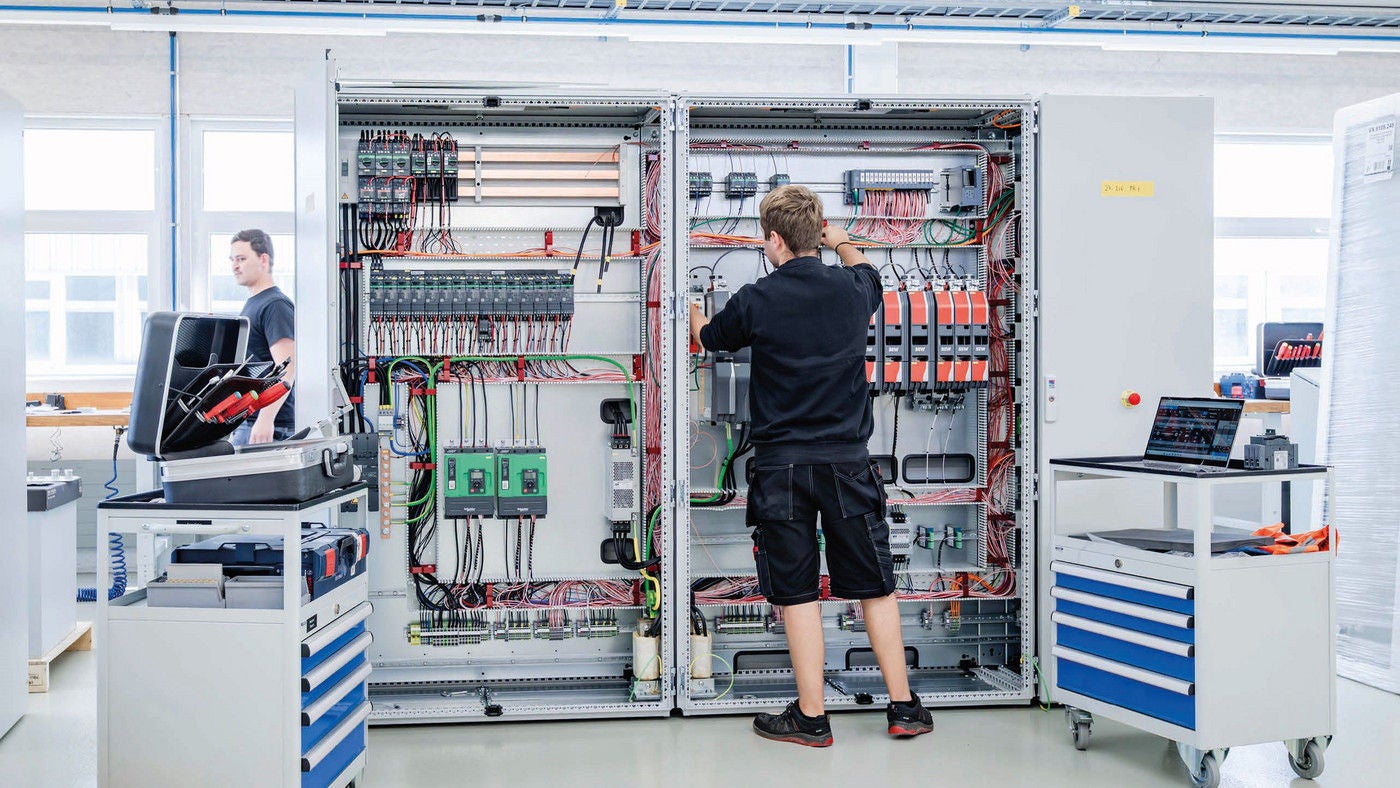
For Louis Stuber, the focus going forward will be on fine-tuning. The aim is to further refine the processes and expand them in order to become even a little more efficient. In addition, plans are in place to introduce additional specialisations in engineering. This also involves restructuring the division of labour so that rather than having just “one” engineering role, the company can employ a software engineer or an electrical design specialist, for example.
In closing, Nick Schwab and Roger Morgenthaler look into the future. "All in all, this is a step I highly recommend. And with the support of Eplan and Rittal, it was simply brilliant. It's something new, but I think if you want to be competitive and look ahead to the next 10 to 15 years, it's absolutely essential," Bütikofer assures us. You have to set aside time for it, though, and be prepared to deal with the occasional setback—that’s simply part of the process.
Morgenthaler also has hopes for the company's future: "I hope we can keep improving. And that we can continue to motivate our employees to develop further improvements together and put them into practice."
Text : Mag. Barbara Sawka, Freelance Editor, Rittal AG