Closing the Panel Building Skill Gap with Eplan Smart Production
Closing the Panel Building Skill Gap with Eplan Smart Production1
The Problem: Too Much Production Knowledge Lives with Too Few People2
How Eplan Helps Close the Panel Building Skill Gap2
1. Make Complex Panel Building Tasks Easier to Follow3
2. Reduce Dependence on Mentor-Based Training3
3. Make the Workforce More Flexible3
4. Support Quality as Newer Technicians Take on More Work4
5. Keep Production Connected to Engineering4
Panel builders need skilled people to keep production moving, but those people are getting harder to find. Experienced electricians and panel wirers carry years of knowledge about reading schematics, mounting components, routing wires, troubleshooting problems, and knowing what “right” looks like before a cabinet leaves the shop. However, when that experience is concentrated in only a few employees, production becomes harder to scale.
New technicians need more training, senior technicians spend more time answering questions, and absences create bottlenecks. Growing the business may depend on finding skilled people who are simply not available.
Eplan Smart Production helps panel builders address that problem by bringing engineering data directly to the shop floor as clear, step-by-step mounting and wiring guidance.
The goal is not to replace skilled technicians, but to make their expertise go further by providing more technicians with the information they need to complete production tasks accurately and consistently.
The Problem: Too Much Production Knowledge Lives with Too Few People
Traditional panel building often relies heavily on individual experience. A senior technician may be able to look at a schematic and quickly determine where components belong, how a wire should be routed, which terminal comes next, or how to resolve a problem, but a newer technician may need repeated guidance to make those same decisions.
That creates several challenges:
- Experienced employees become production bottlenecks
- New-technician onboarding requires significant mentoring
- Routine work consumes time that specialists could spend on higher-value tasks
- Quality becomes harder to maintain when less-experienced technicians fill production gaps
- Production capacity can become limited by the number of skilled technicians available
A better approach is to make the production process easier to follow.
How Eplan Helps Close the Panel Building Skill Gap
The labor challenge in panel building is largely about making production knowledge easier to access so a broader range of employees can contribute without every task depending on years of experience.
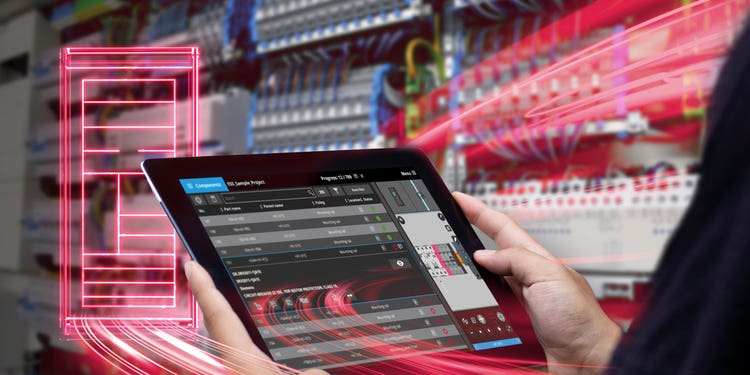
Eplan Smart Production helps do that by bringing engineering data and the 3D digital twin from Eplan Pro Panel directly to the shop floor. Technicians receive guided mounting and wiring instructions, checklists, and 3D visualizations that make individual production steps easier to understand and follow. That allows panel builders to use experienced technicians more strategically while giving newer or less-experienced technicians clearer guidance for appropriate production tasks.
The value becomes especially clear when you look at the specific workforce problems panel builders face, and how guided digital production can help address each one.
1. Make Complex Panel Building Tasks Easier to Follow
One of the biggest barriers for newer technicians is turning engineering documentation into physical work. A schematic created in Eplan Electric P8 contains the electrical design, but a technician still needs to translate that information into mounting and wiring decisions at the cabinet. Smart Production makes that translation clearer.
For mounting, technicians can see where DIN rails, wire ducts, and components belong. For wiring, they can see the individual connection, termination points, and routing path in the 3D model.
Rather than searching through pages of documentation or relying on memory, the technician can follow the next required step. This lowers the amount of interpretation required on the shop floor and gives newer technicians a clearer path through work that would traditionally depend more heavily on experience.
2. Reduce Dependence on Mentor-Based Training
Training new panel builders traditionally requires time from the experienced technicians a company can least afford to pull away from production. Smart Production helps shift some of that everyday guidance into the digital workflow.
The system leads technicians through mounting and wiring tasks sequentially, with visual confirmation of what needs to be installed or connected. Newer technicians can learn while completing structured production work instead of depending on a senior employee to explain every step.
That does not eliminate training or the need for qualified expertise, but it does help make routine production knowledge more accessible so specialists can spend more of their time on troubleshooting, complex work, quality, and other tasks where their experience creates the most value.
3. Make the Workforce More Flexible
When only a few employees can perform critical panel-building tasks, vacations, absences, turnover, and peak demand can quickly disrupt production. Guided digital work instructions give panel builders more flexibility in how work is assigned.
The value here is making a broader group of employees productive on appropriate production tasks while allowing specialists to focus where their expertise is truly required.
For growing panel shops, that can help reduce the extent to which throughput is tied to the availability of only a handful of experienced employees.
4. Support Quality as Newer Technicians Take on More Work
Expanding the production workforce only helps if quality remains consistent. Smart Production provides visual guidance for individual work steps and tracks whether components and connections have been completed. Technicians can see what still needs attention while completed work is documented through the production workflow.
For wiring in particular, the technician can follow routing information derived from the digital twin rather than determining the route independently at the cabinet. That provides a more repeatable process for technicians with different experience levels.
It also makes handoffs easier. If another employee needs to continue the job, the production status provides a clearer picture of what has already been completed and what remains.
5. Keep Production Connected to Engineering
The labor gap becomes even harder to manage when the shop floor also has to compensate for an unclear engineering handoff. Smart Production helps connect those two sides of the business.
Engineering creates the project data and 3D digital twin in tools such as Eplan Electric P8 and Eplan Pro Panel, and Smart Production then makes relevant information available to the people physically assembling and wiring the cabinet. When changes occur, Smart Production can also show updated information and guide technicians through differences in the work instructions.
That means fewer production decisions need to depend on somebody knowing which drawing is current, remembering how the last cabinet was built, or interpreting an engineering change from scratch.
6. Give Production Managers Better Visibility
The skills gap is also a production-management problem because managers need to know where jobs stand, where work is slowing down, and how their available workforce can be assigned effectively.
Smart Production provides order and progress information through a centralized production workflow; managers can monitor jobs, processing times, and potential bottlenecks rather than relying only on informal shop-floor updates.
That visibility can make it easier to balance workloads and use experienced technicians where they are most needed.
The Big Picture: Make Skilled Labor Go Further
The skilled-labor shortage is not something panel builders can solve simply by hiring more people. The stronger approach is to make production knowledge easier to transfer, routine work easier to follow, and experienced employees more valuable where their expertise matters most.
Eplan Smart Production helps do that by turning engineering data and the digital twin into guided mounting and wiring workflows for the shop floor. The result is a panel building production process that can be easier to train, more repeatable across technicians, and less dependent on a small number of experienced technicians.
Want to make your panel-building workforce more flexible? Contact Eplan to learn how Eplan Smart Production can help bring guided digital workflows to your shop floor.