How Eplan Helps Mobile Equipment Manufacturers with Speed, Accuracy, and Service Made Simple
End-to-End Workflow: From Electrical Schematics to Machine Cabling and Hose Routing2
Create the Machine’s Electrical and Control Documentation in Eplan Electric P82
Bring Hydraulic and Pneumatic Engineering into the Same Software Environment3
Specify Hoses and Fittings Clearly with the Fluid Hose Configurator3
Plan Real Routing in 3D with Cable proD—Before the First Prototype Is Built4
Route Hoses and Tubes in 3D (and Tie It Back to Fluid Schematics)4
Why This “Single Data Backbone” Matters for Mobile Equipment Programs5
Improves Procurement and Prefabrication Readiness5
Eplan Platform addresses these by creating a consistent, data-driven engineering foundation, starting with schematics and extending into 3D layout and routing, so manufacturing and assembly can rely on a digital twin rather than tribal knowledge and prototype “measure-and-adjust” work.
End-to-End Workflow: From Electrical Schematics to Machine Cabling and Hose Routing
Modern mobile machines are complex, integrated systems where electrical, hydraulic, and pneumatic disciplines must be engineered together from the start. A fragmented approach to documentation and routing often leads to late design changes, sourcing errors, and costly shop-floor rework. The following steps outline how a unified, Eplan-based workflow supports mobile equipment manufacturers in creating a consistent digital backbone, from control schematics and fluid power design to 3D routing of cables and hoses, well before the first prototype is built.
Create the Machine’s Electrical and Control Documentation in Eplan Electric P8
For mobile equipment, the schematic is more than a drawing. It’s the master dataset for the product’s control system. Eplan Electric P8 is designed for electrical and fluid control design and documentation, enabling creation of single-line or multi-line schematics, wiring diagrams, and automated reports like BOMs, wire lists, I/O lists, and cable diagrams. It supports standardized, template-based engineering approaches and provides “part of the Digital Twin” for the control system.
What this means for a mobile machine program:
- You can structure projects consistently (across models or variants).
- You generate manufacturing-ready outputs (wire lists, terminal diagrams, device lists) early.
- You reduce errors with data-driven connectivity and automatic evaluations.
Bring Hydraulic and Pneumatic Engineering into the Same Software Environment
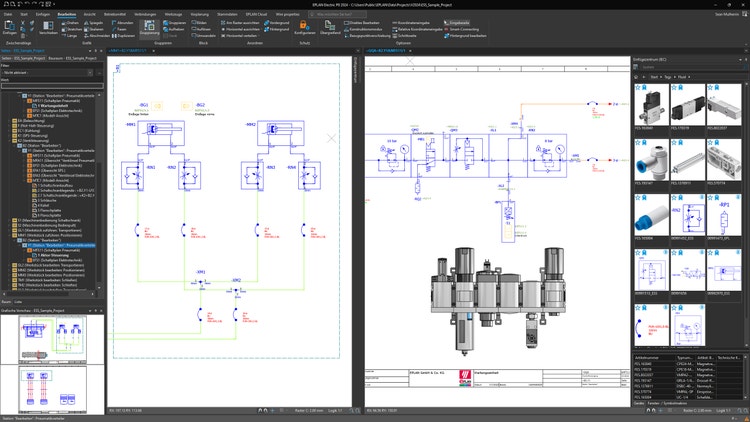
Most mobile equipment is inherently mechatronic: electrics and fluid power must work together (e.g., electrohydraulic valve manifolds, pneumatics for auxiliaries, lubrication/cooling circuits, etc.). With Fluid Schematics (fluid power engineering within the Eplan environment), engineers can design and document:
- Pneumatics
- Hydraulics
- Cooling (not HVAC)
- Lubrication
It includes an ISO 1219 symbol library and supports standards-based identification (e.g., ISO 1219 / IEC 81346) and automatic cross-references between fluid power and electrical engineering.
Why this matters in mobile equipment:
- Electrical IO, sensors, and actuators can be aligned with hydraulic/pneumatic functions.
- Documentation stays consistent across disciplines. This is critical for commissioning and service.
Specify Hoses and Fittings Clearly with the Fluid Hose Configurator
Beyond drawing the hydraulic schematic, mobile OEMs need procurement-ready hose definitions. The Eplan Fluid Hose Configurator provides a wizard to fully specify a hydraulic hose line and automatically generate a norm-compliant type code (e.g., rules aligned to DIN 20066). It also supports generating report pages so purchasing and suppliers receive unambiguous hose documentation.
Practical outcome:
- Fewer hose ordering mistakes
- Faster sourcing
- Better repeatability across variants and production batches
Plan Real Routing in 3D with Cable proD Before the First Prototype Is Built
Mobile equipment cabling often becomes a late-stage fire drill: the machine is assembled, the cabinet is mounted, then teams figure out routing and lengths on the shop floor. Eplan Cable proD shifts that work upstream by enabling the efficient design of cabling in machines with early and reliable cable length determination, improving production reliability and enabling procurement of pre-assembled cables. It integrates into existing processes by transferring connection information and digital control cabinet layout from the Eplan project, plus data exchange with MCAD systems.
How this helps mobile equipment manufacturers specifically:
- Harness needs & cable BOM accuracy: you can quantify what’s needed earlier by length and route. This reduces waste and change orders.
- Routing assurance: you validate routing pathways in the 3D model (including through ducts or trays and along machine structures).
- Installation guidance: technicians can install with fewer interpretive steps and fewer “custom on-the-spot” adjustments.
Route Hoses and Tubes in 3D and Tie It Back to Fluid Schematics
Mobile equipment isn’t only cables; it’s also hydraulic hoses and pneumatic tubing that must be routed with correct clearance, bend radius, and serviceability. Eplan supports cross-discipline continuity here as well:
- Fluid schematics provide the fluid power circuit definition (hydraulics/pneumatics/etc.).
- If a project contains Fluid Power data, it can be used in Eplan Pro Panel “as the basis for routing hoses (tubes) and pipes in 3D.”
This is especially valuable for mobile equipment where hose routing is tightly constrained by articulation points, protective structures, and maintenance access. The result is a more complete digital twin and one that includes both electrical connectivity and the physical reality of fluid power routing and fittings requirements (defined clearly via hose configuration and documentation).
Why This “Single Data Backbone” Matters for Mobile Equipment Programs
Reduces Late-Stage Surprises: Cable and hose length/routing issues are common sources of rework during assembly. With upstream planning (schematics → 3D routing → manufacturing outputs), teams catch conflicts earlier and prevent schedule slips.
Improves Procurement and Prefabrication Readiness: Eplan Cable proD’s early length determination and manufacturing-ready documentation supports ordering pre-assembled cables and reduces material waste.
Unifies Electrical and Hydraulic/Pneumatic Documentation: Using fluid schematics and hose configuration within the same ecosystem improves cross-references, standardization, and supplier communication.
The Next Leap Forward
By bringing electrical, hydraulic, and pneumatic design together on one data-consistent platform—and extending that intelligence into 3D cabling, harness, and hose routing—Eplan provides mobile equipment manufacturers a practical way to engineer smarter, build faster, and service more confidently. From the first schematic through accurate harness calculations in Cable proD, to clearly specified hoses and fittings and validated routing in 3D, your team can replace guesswork and rework with a reliable digital foundation that supports every phase of the machine’s lifecycle.
If you’re designing mobile machines and want to tighten up your engineering workflow, reduce prototype loops, and standardize how you handle wiring, hydraulics, and pneumatics, now is the time to take a closer look at what Eplan can do for you. Reach out to Eplan to discuss your current design challenges, see the platform in action, and explore how an integrated electrical and fluid engineering environment can fit into your organization’s processes.