Introducing Eplan Copilot
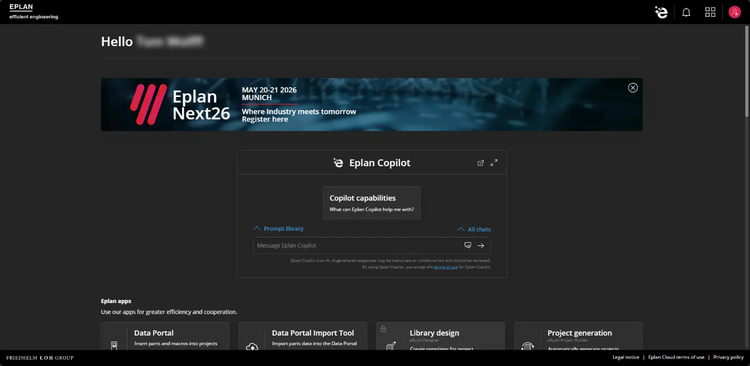
A new tile shows up on the dashboard, reading “Eplan Copilot.” It’s been prominently displayed at the very top– one of the few visual distinctions within the Eplan interface. At first glance, the tile’s familiar, functional design may conceal the powerful capabilities that await users. After all, this new AI-based assistant is designed to simplify and accelerate engineering processes. It is a natural extension of Eplan’s portfolio and commitment to efficiency and innovation.
Eplan Copilot: Engineering made easier and faster
Eplan Copilot achieves this goal by relieving users of the so-called repetitive tasks. To ensure that the solution will provide users with a real and lasting value and pave the way for further developments, a thorough evaluation was needed: determining how AI can be utilized in the Eplan ecosystem.
“Instead of gotten swept up in the hype, we took our time to create a strong foundation”, says Eplan CEO Sebastian Seitz, explaining the company’s approach – and hinting at the divergence between “simple” AI solutions and corresponding concepts in engineering: Artificial intelligence has by now firmly established itself in many areas of daily life; the “question-and-answer game” with Large Language Models like ChatGPT and others has long since become a habit. For an AI solution in engineering, however, Eplan could not conceive of using a “trial-and-error” approach. Results based on AI are always an expression of probabilities. Engineering, however, is a precise discipline demanding 100 percent correct answers.
Eplan took a comprehensive approach to the idea – guided by a vision of a sustainable and secure AI solution being built on a well-thought-out architecture. Issues such as cloud integration, knowledge management, desktop environment integration, and partner integrations all influenced the design of that architecture. And everything needed to be right from the very beginning.
Eplan Copilot: Innovation with substance
This is what Eplan calls “innovation with substance”. It includes a full understanding of the challenges electrical designers face. Such as increasing complexity, expanding systems, greater connectivity, and a growing flood of information. And the answer that Eplan has found is relevant knowledge is needed and must be easily accessible at the right moment.
Eplan Copilot was designed as a new way to interact meaningfully with engineering software. It enables users to formulate their tasks in a natural language, rather than menu paths or function names, but directly within the working context. The intention is to make complex tasks easier to manage, projects faster, and improve overall quality by making high-quality data more readily available. As a result, the time to value is reduced significantly.
The key prerequisite is that all answers are accurate. In other words, that the AI does not “hallucinate.” Eplan Copilot meets this requirement by relying exclusively on verified knowledge. It has been trained on relevant and verified information so that it can answer users’ questions accurately. The architecture also allows customers to add their own knowledge or that of third parties. To support users in their work, Eplan Copilot has a foundational set of skills already built in by Eplan, providing immediate functionality that can be further developed over time.
Eplan Copilot: Equipped with safety
Particular attention is being paid to data security – and in this regard, Eplan Copilot does not differ from other Eplan solutions. Not only is the data transmission path from the customer’s local environment to the AI encrypted, but the cloud itself also meets the highest security standards, as evidenced by certifications such as ISO 27001, TISAX, SOC 2, and MLPS 2.0. Eplan thus addresses potential additional risks with its proven, professionally operated infrastructure.
Eplan Copilot: A cloud-based solution
All of this comes together in the Eplan AI. “The Eplan Copilot is our concept for using AI in an engineering solution”, Marcus Reitz sums it up. The Eplan Head of Technical Prototyping has been involved in the development from the very beginning. “Eplan Copilot is designed specifically for the Eplan ecosystem”, explains Reitz. “For example, it can search through schematics, work with the Eplan Data Portal, and prepare support tickets”, he elaborates. “In doing so, the AI in Eplan Copilot decides whether information needs to be searched or functions need to be executed, or a combination of both.”
For Reitz, the key advantage of the assistant is the fact that it is available as a cloud service. “We opted for an integration that not only offers AI locally within the engineering tool but also makes it available centrally and globally. This allows us to roll out features faster without requiring new installations at the customer’s site. In addition, we have our own large service ecosystem: the Eplan Data Portal, ePocket, and other cloud services. The Copilot can gradually leverage all of it and will be visible everywhere in the Eplan ecosystem in the future.”
Eplan Copilot: Ongoing development
“Eplan Copilot is less of a standalone product but more of a central component of our platform strategy, which will make Eplan more modern and complete”, says Sven Müller, Vice President of Infrastructure Solutions, whose responsibilities not only is integration but also ensuring technical quality. He also oversees the further development of artificial intelligence. “I find the idea particularly exciting that the Copilot will be able to actively perform actions in Eplan Electric P8 in the future – in other words, not just providing knowledge, but taking over actual work steps and intelligently summarizing results. Equally appealing is the component selection, for example for suitable Rittal cooling units, because this is where engineering logic and partner data converge”, Müller enthuses. “Both approaches demonstrate how the Copilot can become a true work assistant in the long term -and already offers significant added value.”
Eplan Copilot: The first step taken
For now, this is still a long way off. However, Eplan has taken the first steps toward integrating AI into engineering. And those in charge are convinced that development will now move forward rapidly. By constantly expanding the knowledge base and continuously increasing skills, the Eplan Copilot will be able to provide more and more support. From co-pilot to pilot, from automated to autonomous engineering: that is the Eplan Vision.
Always up to date
Since 2019, Eplan has been exploring machine learning – the foundation of AI. With the emergence of the first Large Language Models in early 2023, we began researching the topic. The concept for Copilot was developed starting in 2024 and validated with customers. Product development began last year. The first release is now available.
Want to know what other topics we’re driving forward? Then take a look at our website – there, we present our innovations in one place.