

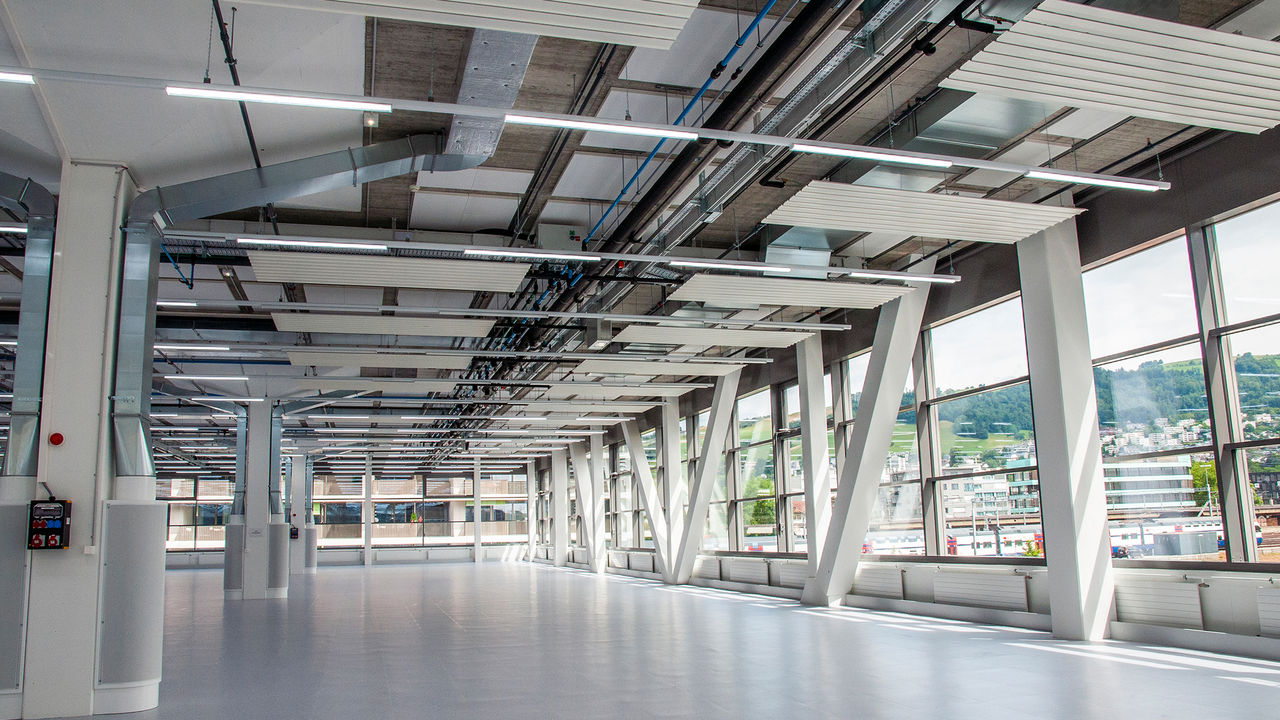
The Siemens Smart Infrastructure division specializes in complex building automation projects, such as hospitals and large data centres (see insert). Among the many large-scale planning projects, one commission in the company’s Dresden location surpassed them all: the planning of the building automation systems for a production facility. More than three hundred automation points (control cabinets), spread across numerous trades, had to be planned within twelve months.
WANTED: A process for accelerated preplanning
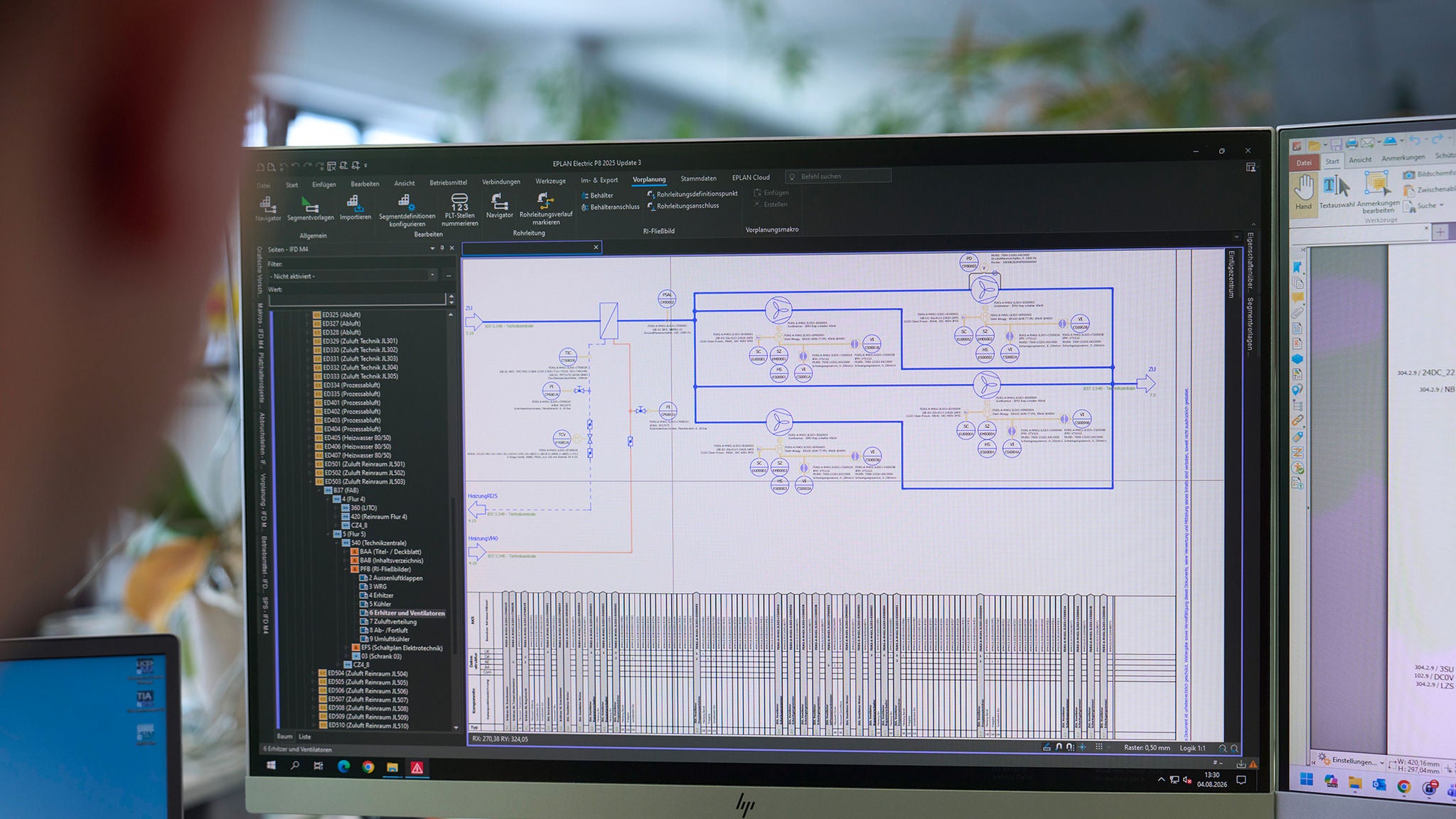
Before the first data arrived, the project team, headed by Siemens Lead Engineer Rico Gollmann, investigated how such a project could be completed within the given time frame—and found the answer in Eplan Preplanning. Gollmann was familiar with the tool for electrotechnical preplanning from a previous job and immediately got the green light from his managers. Eplan Preplanning stood out not just because of its quick preplanning of automation diagrams, instrumentation lists, data point lists, and function lists, but also because of its ability to seamlessly coordinate with the many project partners.
As Gollmann explains, “We receive the design documents from the planners, prepare them, and import them into the Eplan Platform. Then, within Preplanning, we create the automation diagrams, add product information, and, as an example, define the data point properties that will be used for input/output assignments at a later stage in the process. In the run-up to the project, we were in constant contact regarding the definition and use of labels, macros, and properties for the data transfer to Siemens WKC. As a result, the WKC was able to use the Eplan Platform and our preplanning data to generate initial schematics in a partially or fully automated way. This means that we have a consistent, always up-to-date foundation of data for each control cabinet at all times, and there are no gaps or inconsistencies in the data at any point until the control cabinet is completely constructed. Without this, we never could have managed it, given our tight schedule. By using the Eplan Platform and the coordinated processes between the two Siemens divisions, the time required to create the schematics and control cabinets for the building automation project was reduced from several days to just a few hours.”

Working in parallel with a high degree of complexity
Yet this dramatic increase in efficiency isn’t just a result of faster data enrichment and processing within the linear planning process. The new process also enables a greater degree of working in parallel. Gollmann: “The design companies send us around 50,000 documents, which we then organize into lists and check for consistency across all related documents.
In parallel, while preparing and importing them into Eplan Preplanning, we also generate approval documents that are reviewed by the design firms, as well as cable pull lists for the construction site. This also means that we can start with the programming early on.” This large-scale project—which encompasses more than 30,000 data points and nearly 12,000 field devices—is made even more complex by the user’s extremely demanding requirements for high availability and redundancy. How can this complexity be managed at the programming level? Gollmann: “A colleague developed a tool that automatically generates the standard code based on our preliminary planning data, which saves time.”
Preplanning with benefits
As far as Siemens is concerned, the clear advantages of Eplan Preplanning become evident in the day-to-day planning work. As Gollmann summarizes: “We import the data we receive and use the Eplan Platform with Preplanning as the single source of truth for the building automation systems, which is available to everyone involved in the project—and there are many. Thanks to its multi-user capabilities, everyone is working on this single platform and changes are available to them almost in real time. This makes it possible for us to work collaboratively, in parallel, and allows us to achieve the speed that we need, working with a minimal error rate and quickly incorporating changes, which occur very frequently for such systems.
After preplanning, fast control cabinet construction
Siemens Smart Infrastructure in Dresden is currently using seven Preplanning licenses. As soon as the preplanning for one of the 330 control cabinets—the number increased by an additional 30 during the planning phase—is complete, the team transfers the data to the Siemens Combination Technology Plant (Siemens WKC) in Chemnitz, a division of Siemens Digital Industries that won the bid for the control cabinet construction.
In the lead-up to the project, those responsible for it—at Siemens WKC, this is Franz Grünert—agreed on standards for the data transfer, including components, macros, drawings, and labelling. Gollmann: “We developed a process that works very well in practice, following the maxim ‘a control cabinet every day.’”
Planning without media disruptions
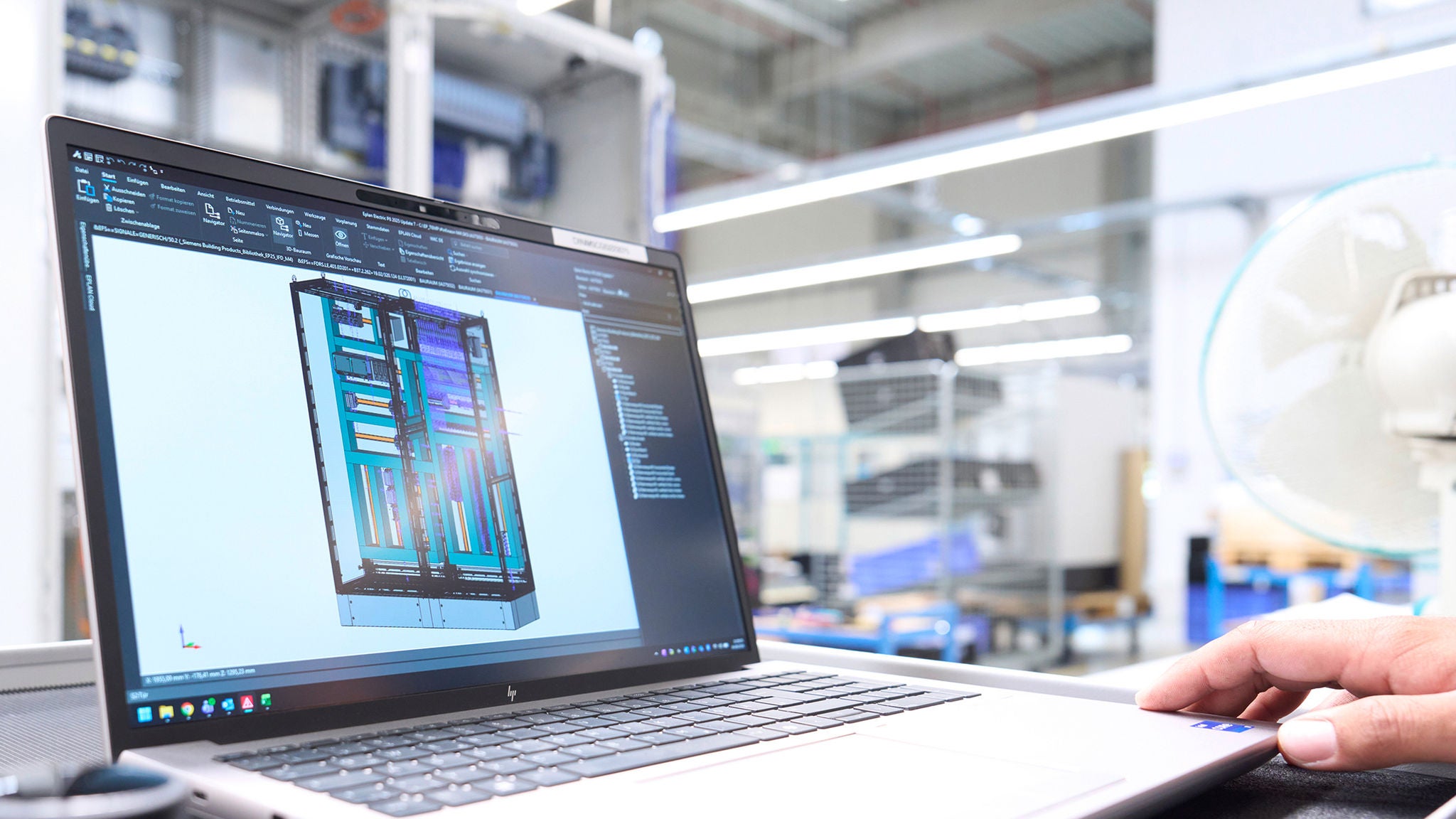
This process runs so smoothly in part because Siemens WKC has been a perfect example of how to completely digitize a process chain for control cabinet construction—from the planning to the construction of highly customized control cabinets. The tempo at which WKC creates the schematics is also impressive to the preplanners. Gollmann: “Even the four of us are barely able to keep our coworkers at WKC working at full capacity.” Here is where the end-to-end integration of the Eplan Platform between preplanning and schematic creation also proves its value, something that also extends to the business side of the process.
Siemens WKC Senior Head of Design Engineering Uwe Zimmermann explains: “Ordering materials, production planning, building the control cabinets—it all requires advance planning and takes time. For building automation systems, the cycle times for these processes are significantly shorter than they are for special-purpose machine construction. And change management—specifically, planning during construction—presents completely different challenges, but we have them well under control.”
Configurators as accelerators
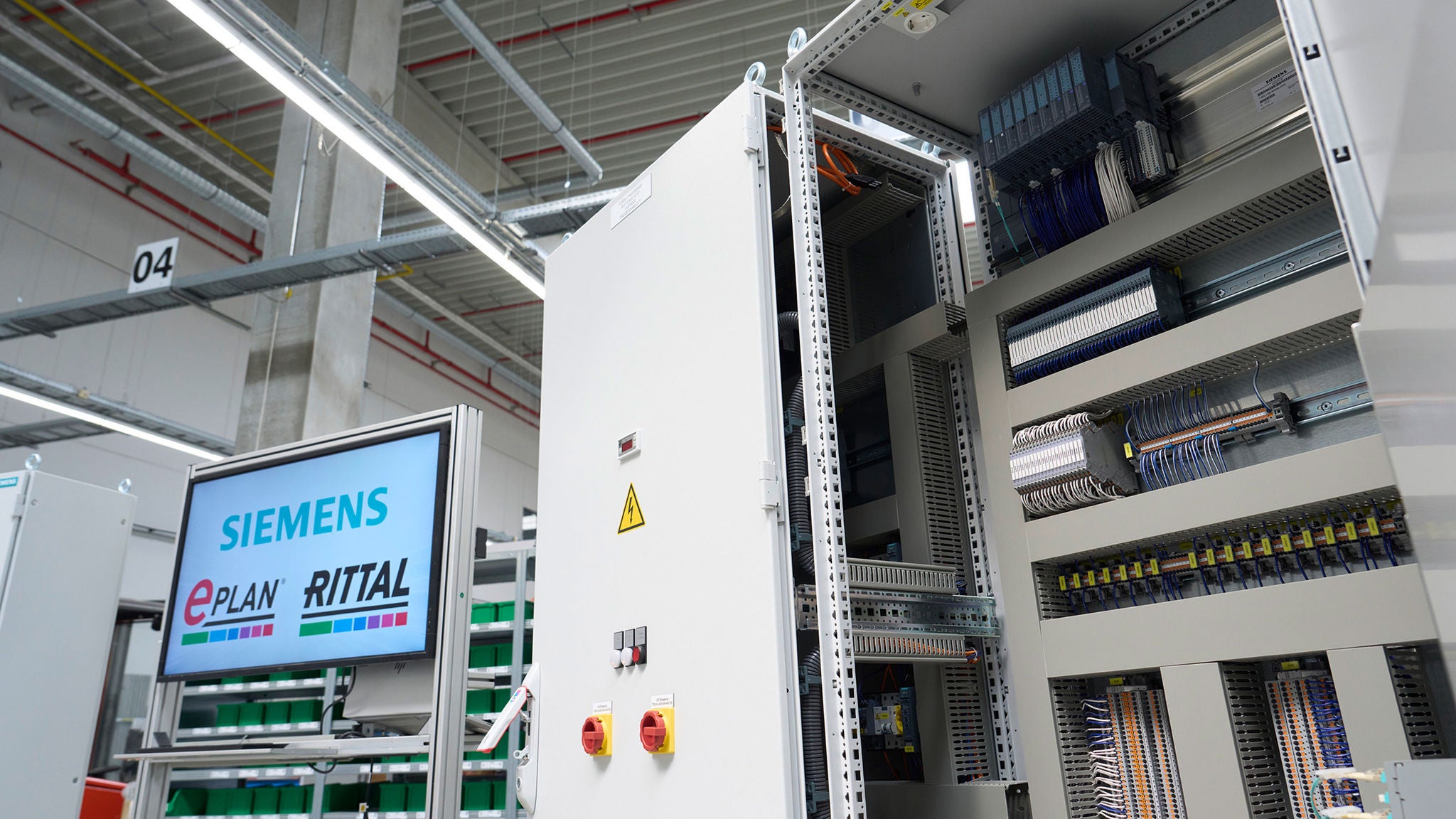
In this regard, in-house configurators developed for the Eplan Platform—at Siemens in both Dresden and Chemnitz—play a key role. Zimmermann: “We use automated, rule-based, or modular engineering and work intensively with configurators that can also be specific to a project.” The same holds true for building automation systems, for instance in the area of fire protection.
Gollmann cites an example from preliminary planning, specifically its integration with programming: “A coworker wrote a configurator that imports the planning data standardized in Eplan into Siemens’s distributed control system, SIMATIC PCS7. There, the entire standard programming is created immediately—including data point links, lists, and input and output assignments. Now all that’s left to do, broadly speaking, is to program the deviations from the standard.” This naturally saves time and increases reliability. Furthermore, it allows the processes for planning, control cabinet construction, and programming to all be carried out in parallel.
Conclusion: Fast tracking control cabinet planning
The cooperation and collaboration between the two locations, which belong to two different Siemens divisions, advanced the automated planning of the building automation system and significantly accelerated the entire process, all the way through to the on-site commissioning of the completed control cabinets. As a matter of fact, it even ended up being easy to plan and build the thirty additional “unplanned” control cabinets—a number that also illustrates the flexibility of those involved, or to put it another way, the challenge of undertaking further planning as construction progresses. Without a consistent foundation of data and end-to-end planning from the very start, it probably would have been almost impossible.
What also contributed to the consistency of the planning process and overall speed is the fact that WKC uses Rittal control cabinets, and not just for this project. Zimmermann: “Rittal is very accommodating in supplying us, even when it comes to custom solutions.” Standard enclosures are delivered daily via the Gera Logistics Centre, always within twenty-four hours. At Siemens WKC these are then machined to customers’ orders on three Perforex MT milling terminals or the Perforex LT laser machining terminal. The data for the machining comes from Eplan Pro Panel and supports automated and rapid manufacturing.
From the perspective of everyone involved, this project could serve as a model for future (large-scale) building automation challenges. Zimmermann: “We can draw a comparison to other automation-oriented industries, such as the automotive sector and machine tool manufacturing. For building technology and building automation systems, we see a great deal of potential for increasing efficiencies. Our goal is to work together with our colleagues from Dresden and from Eplan to fully exploit this potential and to further automate the planning phase. The technology and opportunities are already in place. Everyone involved in the construction project will benefit from this, including the investors and future users.”

Automating, Digitising, and Parallelising—Sophisticated Building Automation Systems from Siemens Smart Infrastructure
Siemens Smart Infrastructure develops smart, digital solutions for buildings, power systems, and industries—with circa 79,400 employees worldwide. As a solutions provider for complex building automation projects, Siemens utilizes state-of-the-art, end-to-end engineering processes that ensure a high level of data consistency and data quality while also enabling the early implementation of parallel processes that previously had to be carried out sequentially.
Siemens supports its clients throughout the entire project—from plant and installation planning to automation system design, control cabinet delivery, field device installation, programming, and commissioning.