Why Spreadsheet-Based Engineering is Holding Electrical Power Engineers Back

Why Spreadsheet-Based Engineering is Holding Electrical Power Engineers Back1
The Reality of Spreadsheet Engineering in Electrical Power1
The Problems Spreadsheets Create in Design and Production2
Massive Manual Effort and Lost Engineering Time2
Duplicate Data and Error Risks2
No Digital Connection to Manufacturing2
No Foundation for a Digital Twin3
How Eplan Products Solve Spreadsheet Engineering Problem3
Eplan Electric P8: The Core of Professional Electrical Design4
Eplan Pro Panel: 3D Control Cabinet and Switchgear Design5
Eplan Engineering Configuration (EEC) & Project Generation (eBuild): Automated Schematic Generation5
Eplan Data Portal: Reliable Component Data from Hundreds of Manufacturers6
Eplan ERP/PDM Integration Suite: Closing the Enterprise Data Loop6
The Reality of Spreadsheet Engineering in Electrical Power
Electrical Power engineering, spanning substations, grid infrastructure, renewable energy systems, and power distribution, are among the most documentation-intensive disciplines in the industrial world. Power assets and facilities have lifespans of 40–50 years for primary equipment and 15–20 years for secondary equipment, meaning the documentation created today must remain accurate, accessible, and maintainable for decades. Yet across the energy sector, too many engineering teams still rely on spreadsheets, CAD drawings, and disconnected tools as their primary design and documentation backbone.
This approach is no longer viable and actively undermines project quality, timelines, and an organization's ability to scale.
The Problems Spreadsheets Create in Design and Production
Spreadsheets were never designed to handle the complexity of modern electrical engineering and energy infrastructure projects. The following challenges highlight the limitations of spreadsheet-driven processes.
Massive Manual Effort and Lost Engineering Time
Spreadsheet workflows require engineers to manually create and maintain device lists, BOMs, wire lists, cable diagrams, terminal plans, and I/O lists. Every update must be cross-checked by hand, consuming valuable engineering time. In today’s energy sector, where project volumes are rapidly increasing, this level of manual effort is highly inefficient.
Duplicate Data and Error Risks
Using spreadsheets alongside 2D CAD tools to create multiple sources of truth adds the challenge of keeping both up to date. Changes made in one system often fail to update elsewhere. This leads to mismatched BOMs, incorrect cable data, and documentation errors that may only surface during commissioning~~,~~ when fixes are far more costly.
No Automated Validation
Spreadsheets cannot detect engineering issues such as duplicate device tags, incomplete terminal assignments, or wiring conflicts. Validation depends entirely on manual review, which creates significant risk in safety-critical energy infrastructure projects.
Fragmented Collaboration
Energy projects involve utilities, OEMs, system integrators, panel builders, and service providers. When documentation is spread across spreadsheets, PDFs, and email attachments, version control and coordination become difficult, causing delays, rework, and data loss between partners.
No Digital Connection to Manufacturing
Spreadsheets are isolated documents that cannot drive automated manufacturing. Cable lengths, drilling patterns, routing, and component placement must be recreated manually on the shop floor, increasing errors and rework.
Difficult to Standardize
Without a centralized database-driven system, maintaining consistent naming conventions, device tags, symbols, and cable standards across projects is extremely challenging. Individual spreadsheet methods vary by engineer, making knowledge retention and scalability difficult.
No Foundation for a Digital Twin
Modern energy infrastructure increasingly depends on accurate digital representations of physical systems known as digital twins. Spreadsheet-based engineering cannot support this level of connected, lifecycle-ready data, which limits visibility, maintenance efficiency, and future modernization efforts.
How Eplan Products Solve Spreadsheet Engineering Problem
The Eplan Platform is a data-driven engineering environment purpose-built for electrical, automation, and power engineering. Unlike spreadsheets and generic CAD tools, every piece of data in an Eplan project is stored once in a structured database, and is automatically connected to all related schematics, reports, and 3D models. Here is how each Eplan solution addresses the specific pain points above:
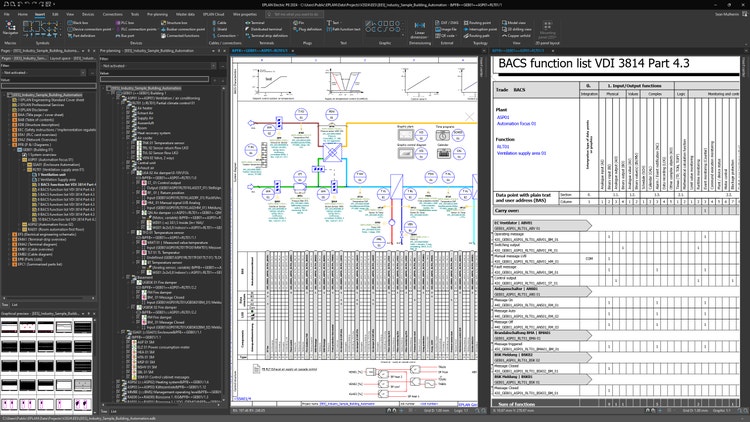
In spreadsheet workflows, the preplanning phase is often a loose collection of Excel tables, diagrams, and text documents with no structured data connection to downstream engineering. Eplan Preplanning replaces this by enabling engineers to record, edit, and update engineering data from the very first project phase. This includes Electrical & Instrument Diagrams (E&IDs), plant/machine overviews, and single-line diagrams that directly feed into detailed design. Data imported from external tabular sources (including existing spreadsheet files) is immediately structured and connected to the Eplan data model, so nothing needs to be re-entered later. For energy projects, this means the single-line diagram used by planners flows seamlessly into the detailed digital twin.
Eplan Electric P8: The Core of Professional Electrical Design
This is where the most dramatic departure from spreadsheet-based engineering occurs. Eplan Electric P8 is a data-driven CAE software for electrical design and documentation. Rather than drawing schematics in a generic tool and maintaining separate spreadsheets for parts data, every component in an Eplan schematic carries its full data set, including article number, manufacturer, electrical properties, terminal assignments, and more.
Integrated engineering platforms eliminate many of the limitations created by spreadsheet-based workflows by centralizing project data and automating critical processes. Reports such as BOMs, wire lists, cable diagrams, terminal diagrams, and I/O lists are generated automatically and update instantly when project changes occur. Standardized macro technology enables proven circuit designs to be reused across projects~~,~~ while auto connecting reduces manual wiring errors in schematics. Built-in validation tools automatically detect inconsistencies, duplicate device tags, and missing connections, improving overall project quality.
Eplan Pro Panel: 3D Control Cabinet and Switchgear Design
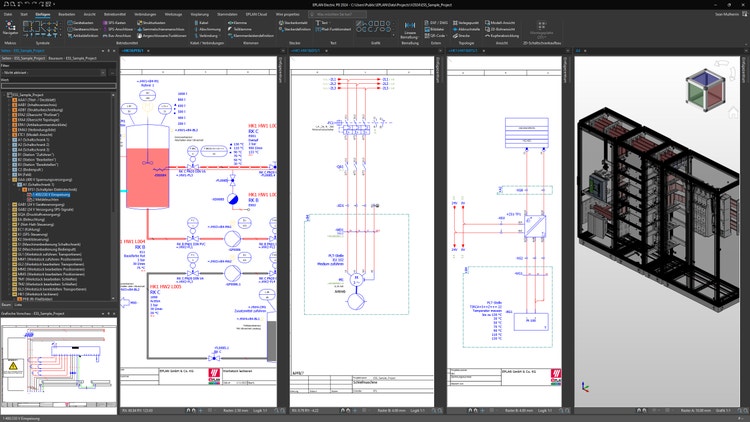
Spreadsheets and 2D drawings cannot fully represent the physical reality of a control panel. Eplan Pro Panel enables engineers to design control panel enclosures, switchgear, and power distribution systems in 3D, from mounting layout to virtual routing of connections to thermal analysis and cooling unit planning. This creates a complete digital twin of the control cabinet, or switchgear assembly, highlighting space conflicts, thermal requirements, and assembly sequences before physical construction begins. Manufacturing data, including drilling patterns, component labeling, and copper parts specifications, is exported automatically, eliminating the manual re-entry that plagues spreadsheet-based shop floor handoffs.
Eplan Engineering Configuration (EEC) & Project Generation (eBuild): Automated Schematic Generation
For electrical power companies, utilities, OEMs and system integrators with standardized product portfolios (e.g., transformer stations, switchgear configurations), EEC and eBuild enable automated generation of engineering documentation from modular, pre-designed functional units. Instead of copying and modifying old spreadsheets and schematics, engineers configure a product and receive high-quality electrical documentation at the touch of a button. This dramatically accelerates order processing and ensures consistent quality. eBuild's browser-based interface means access is location-independent, and a wizard guides even newcomers through the process.
Eplan Data Portal: Reliable Component Data from Hundreds of Manufacturers
Spreadsheet-based parts management means engineers manually transcribe component specifications from datasheets and catalogs, a tedious, error-prone process. The Eplan Data Portal provides direct access to standardized, manufacturer-verified component data from hundreds of suppliers. Engineers drag and drop real components with complete electrical, mechanical, and 3D data directly into their projects. This eliminates data entry errors and ensures BOMs reflect real, orderable components.
Eplan Collaboration Apps: Connected Teams, Not Disconnected Files
The final and perhaps most transformative advantage over spreadsheets is collaboration. Eplan's cloud-based Collaboration Apps enable:
- Data Management (eManage): Central, cloud-based storage and management of Eplan projects, replacing file shares and email attachments.
- Parts Management (eStock): Centralized parts data accessible across teams and locations, establishing company-wide component standards.
- Project Viewer (eView): Stakeholders across the ecosystem, including operators, maintenance teams, external partners, can view and navigate the complete engineering documentation in a browser, without needing an Eplan license. For electrical power operators and utilities responsible for 24/7 grid availability, this means up-to-date documentation is always accessible.
These apps replace the fragmented workflow of emailing spreadsheets and PDFs between project participants.
Eplan ERP/PDM Integration Suite: Closing the Enterprise Data Loop
Spreadsheets cannot synchronize with enterprise systems. The Eplan ERP/PDM Integration Suite provides standardized and customizable interfaces to ERP and PLM/PDM systems, ensuring that parts data is synchronized and bills of materials transfer seamlessly. This data consistency along the entire value chain — from engineering, to procurement, to manufacturing, to operations — is something spreadsheet-based workflows fundamentally cannot achieve.
In a nutshell, the Eplan platform helps utilities and electrical power design engineers move beyond the limitations of spreadsheets by delivering a connected, automated engineering platform built for modern infrastructure projects. Instead of managing disconnected files and manual processes, teams can automate documentation, reduce errors, standardize designs, and accelerate project delivery from engineering through manufacturing. With integrated data, built-in validation, digital twin capabilities, and seamless collaboration, Eplan enables utilities to improve efficiency, increase quality, and modernize operations for the future.
The Bottom Line
The energy transition is pushing utilities, OEMs, and system integrators to deliver more projects with fewer resources and tighter deadlines. Spreadsheet-based engineering slows teams down with disconnected data, manual rework, and costly errors.
The Eplan Platform replaces fragmented workflows with a connected, data-driven engineering environment that streamlines design, automates documentation, supports digital twin initiatives, and accelerates projects from planning through manufacturing, all from a single data library.
Ready to modernize your engineering workflow? Contact Eplan to schedule a personalized demo and see how utilities and energy providers are improving efficiency, quality, and project delivery with the Eplan Platform.