Eplan creates data consistency in machine engineering
The construction of machines is a complex endeavor. This results in high-tech structures that can do more and should be manufactured as automatically as possible. The competition is fierce. Machine builders are always looking for ways to increase their efficiency. One approach is to shorten the engineering phase and get machines to produce faster. GEA is pursuing this – with Eplan and Rockwell Automation.
GEA designs smart centrifuge — based on Eplan software
GEA, a mechanical engineering company and long-standing Eplan customer, is explicitly looking for complete solutions that reconcile the various engineering disciplines. The company sells machines and systems worldwide with customers in the food, beverage, and pharmaceutical industries. GEA products also include separators, these vertically arranged centrifuges are used to separate and clarify liquids. This includes the GEA ‘Plug & Win-i-Separator’ that was developed for craft breweries and cider producers with the aim of getting more out of every batch.
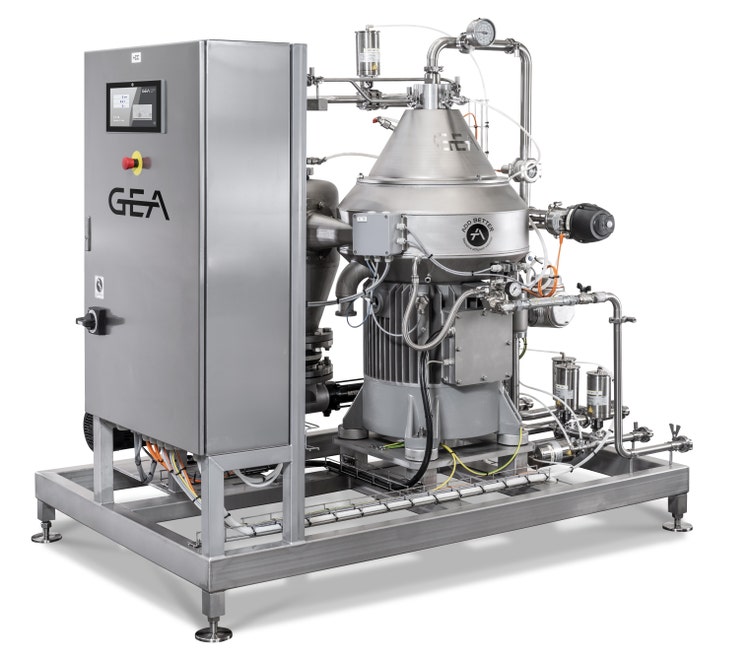
The GEA Plug & Win-i-Separator
The Plug & Win-i-Separator is designed to be ‘data-integrated’. This means that data from the design is also made available for further steps and different trades – by using Eplan as the overarching software and corresponding platform. The enclosure solution comes from Eplan's sister company Rittal. This means that a digital twin can be reliably mapped. For example, GEA's skid separator uses Rittal's stainless steel AX housing, the blue e+ filter fan and the hose-fixed hood for greater protection. Rockwell’s solutions were also integrated as they control the separator. The result: a continuous flow of data from engineering and production through to maintenance and operation.
“One of the most important factors here is the ‘digital twin’ of the machine control cabinet with detailed data on its components,” explains Simon Budde, Head of Partner Management at Eplan. “This also includes the components contributed by our partner Rockwell Automation.”
Eplan’s shared software environment brings big advantages
This is precisely the advantage of an Eplan project: the solution makes it possible for participating trades and different companies to work in the same software environment and for all relevant data to be available in one place. This helps in the design phase – and later during operation, as current documentation is easy to find, and changes are immediately digitally mapped.
This overview is immensely useful, especially when things don't run smoothly. For example, if a machine's motor breaks down, the frantic search for the necessary information often begins, where is the motor located and how is it controlled? However, this information is easy to find in the Eplan project because the interaction of the machine functions is mapped here; information from the piping and instrumentation diagram, for example, is visualized in Eplan Preplanning, the tool for technical pre-planning. The motor can be easily found there and navigated to the corresponding position in the electrical schematics.
The centrifuge motor in question is connected to a drive via a cable. This is a PowerFlex 753 drive from Rockwell Automation – a controller for applications of up to 400 hp and 270 kW. This is one of more than 30,000 Rockwell Automation components available in the Eplan Data Portal. They can be used in Eplan's engineering solutions. A replacement for the defective drive in our example can therefore be organized quickly and easily.
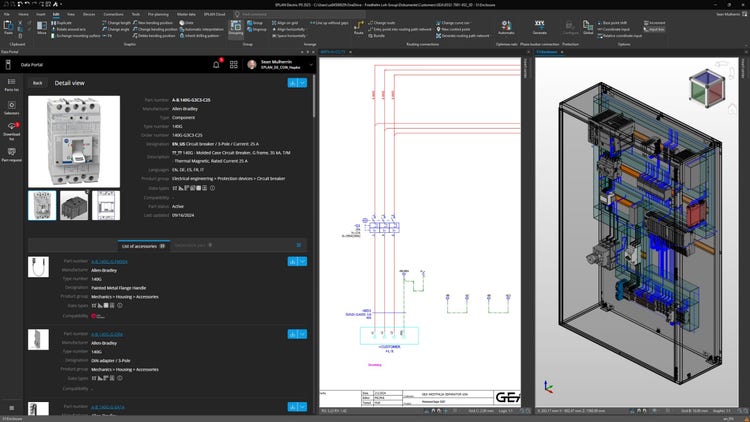
Eplan and Rockwell: Data exchange via AutomationML (AML)
The consistency offered by the Eplan project includes additional benefits, as data can be exchanged automatically and across disciplines. For example, they are transferred to the ‘Studio 5000’ programming environment from Rockwell Automation via an AML interface. This means that the data for programming programmable logic controllers no longer has to be entered separately. Instead, programmers can use the existing data from the Eplan project thanks to the interface.
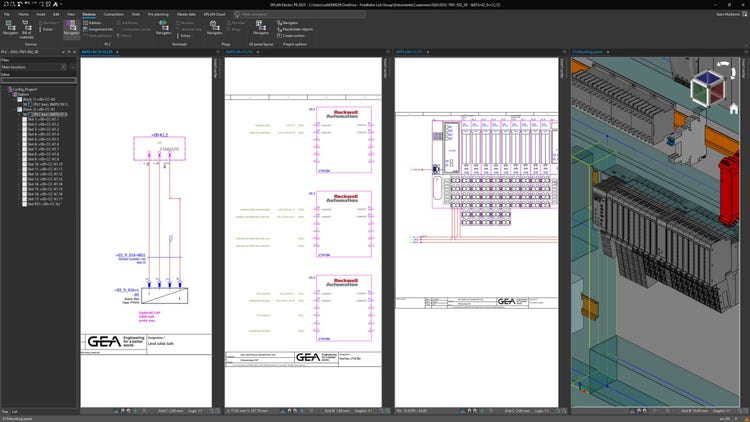
Eplan supplies data in MTP format
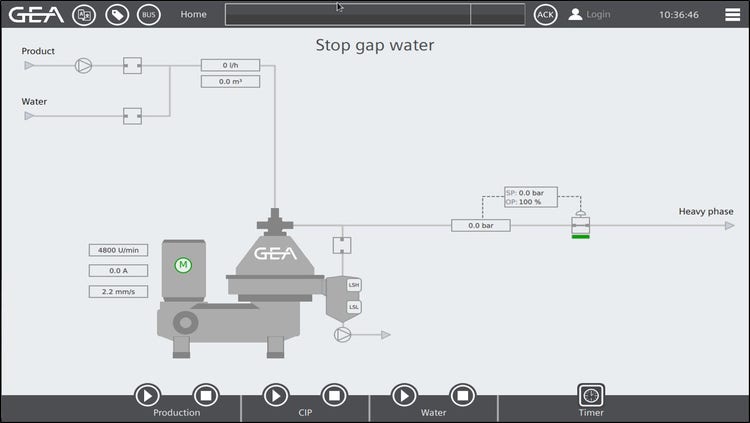
This transferability is not the only thing that has been ‘thought through’. Project data from Eplan can also be exported in MTP format and imported into other systems. This function was used, for example, to make data from process engineering available for further visualization in FactoryTalk Optix. The Rockwell Automation platform is used to improve interfaces and the visualization of data. This data originates from the piping and instrumentation diagram from Eplan Preplanning: relevant information is extracted from here via the MTP interface and transferred to FT Optix.
MTP – short for Module Type Package – Is a manufacturer-independent standard for describing process modules. It is becoming established because the workload for plant manufacturers has shifted from plant engineering to module engineering. The industry has moved towards more and more modular production so that plants and machines can be adapted to different production environments with relatively little effort. GEA has also manufactured its separator according to this principle.
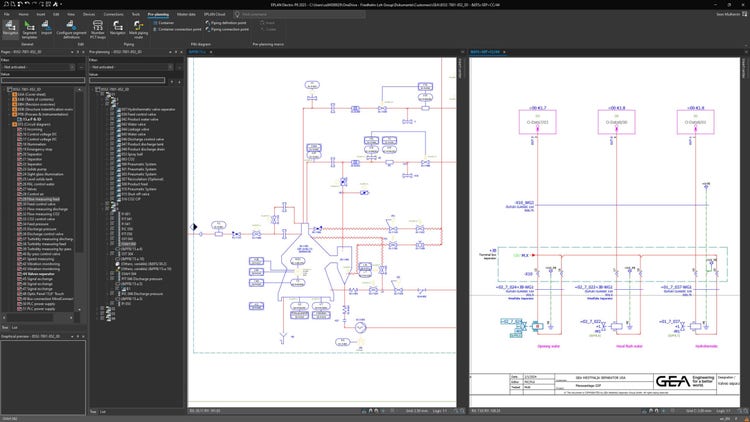
With Eplan, data stays consistent
Eplan supports this principle and correspondingly integrated engineering with its platform solution. The idea is rounded off by the fact that the data is collected in the cloud. For GEA, this means that engineers can access it online via a QR code, which further simplifies handling. A well-thought-out approach – for a highly technical machine.