

The need for high-performance energy and building infrastructure is growing rapidly. At the same time, technical and regulatory requirements are increasing, projects are becoming more complex and have to be realised in ever shorter time frames, while qualified specialists are in short supply. At Light + Building 2026 in Hall 11, Booth B80, Rittal and Eplan will demonstrate how these challenges can not only be overcome but also how projects can be significantly accelerated. Enablers are predefined, standardised solutions and integrated data structures that span from specification through engineering and production to operation.
Light + Building 2026: Rittal and Eplan are bringing speed to the energy and building infrastructures
|
Herborn/Monheim

Well-thought-out and integrated solutions - from engineering to system technology
Power distribution, building automation and IT infrastructure are becoming more powerful and more digital – and consequently more complex. Each additional discipline increases the coordination, testing, and documentation required. At the same time, projects must be implemented more quickly, even though capacities in planning, engineering and assembly are limited. “The real problems are not the individual tasks. They are in the process involved. “The challenge is to integrate planning, engineering, production and operation consistently“, says Rolf Schulte, Global Vertical Market Manager at Eplan. “And speed alone is not enough: Those who plan, assemble, or expand more quickly must not produce more errors. The central question here is: How can projects be sped up without compromising quality?”
Speed and quality are what count
At Light & Building, Rittal and Eplan are responding with a clear, common principle: standardisation and data consistency across the entire building technology value chain. The focus is on pre-designed solutions – application samples – available as digital templates in the Eplan world. They contain structured project data, tested macros and detailed models that can be processed directly, for example, as DC microgrids for lighting systems or AC and DC distributors for photovoltaics.
Users incorporate these templates, adapt them to their specific projects, and achieve their objectives more quickly, with less effort spent on coordination and with a lower risk of errors, rather than rethinking each project from scratch. This makes best practices scalable. Here, high data quality is vital: Only when information is available in a standardised, structured form can processes be automated and new technologies, such as AI, be sensibly integrated into engineering and operating processes. This ensures quality and speed throughout the entire value chain, from specification to operation.
New interface accelerates switchgear planning
The strategic partnership between Siemens and Eplan is also bearing fruit: The “SIMARIS connector for Eplan”, an interface between Siemens’ SIMARIS application and the Eplan Platform, is making its debut at "Light + Building”. The long-term goal is to provide Eplan data for configured Siemens products across the board, so offering switchgear manufacturers and electrical planners “plug-and-play solutions”. In a first step, it is now possible to provide basic structural elements and properties from the SIMARIS configuration in the Eplan Platform. This is necessary to position objects correctly during switchgear planning and to create the switchgear's digital twin.
Consistent thinking in building automation
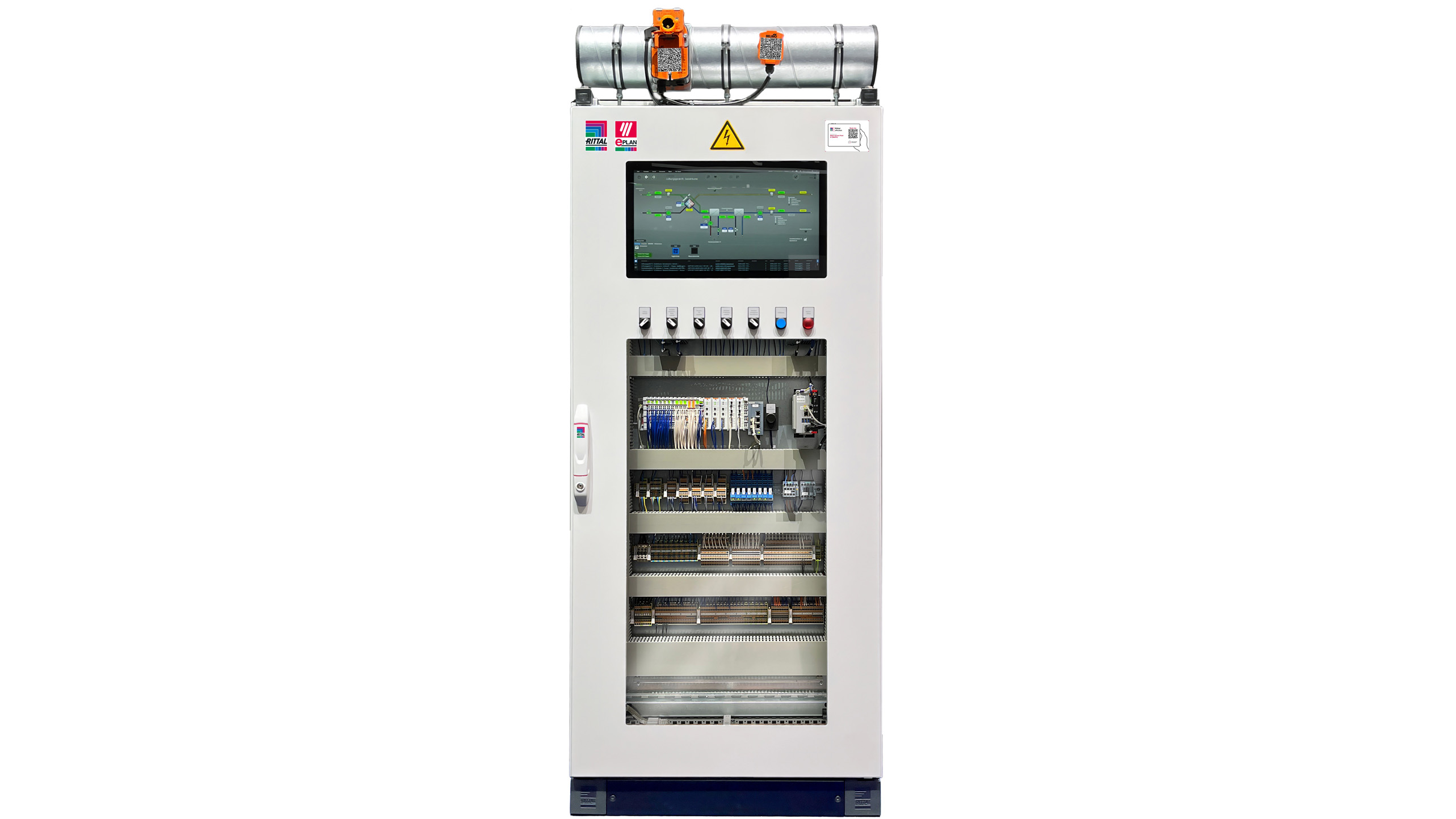
Rittal and Eplan use a practical example to show how an end-to-end process in building automation – from specification to planning and manufacturing to operation – can succeed. The display clearly shows how automated engineering really works. Eplan and Rittal give visitors a practical demonstration of the potential that lies dormant in the process, through standardised data, consistent processes and measurable efficiency gains at all stages of value creation, using the following examples:
- Designing and specifying a system
- Creating measuring and control diagrams, including the data point lists
- Semi-automated schematic creation
- 3D enclosure configuration of an automation focal point
- Providing data for the mechanical production of the enclosure
Standardised power distribution as an accelerator in energy expansion
At the trade fair, Rittal will also use the new RiLineX system platform to demonstrate how standardisation in power distribution specifically affects speed and scalability. Among other things, this addresses applications in buildings, photovoltaic systems and battery storage systems. The new RiLineX system platform speeds up the production of power distribution, so that time savings of up to 75% can be achieved during assembly. Rittal is promoting international standardisation through a consistent platform approach and has initiated an ecosystem with technology partners who are developing ‘Ready for RiLineX’ components. The new technology partnership with PULS is one example. Highly efficient PULS power packs contact the RiLineX board directly and can be installed quickly and without tools.
“Everything we are showing at Light + Building is based on a common aspiration: to think of engineering, manufacturing and operation as one interconnected process,” says Dr. Christian Maryska, Solutions Sales Manager Energy & Power at Rittal. “Standardised platforms, pre-designed solutions and structured data are decisive levers for sustainably increasing the rate at which energy and building infrastructure is expanded, as well as for making the industry as a whole more capable of action.”
Download press kit
- Filename
- 2026-02-eplan-rittal-light-building-2026.zip
- Size
- 6 MB
- Format
- application/zip
Gallery

Pace-setter application samples
Pace-setter application samples: Templates contain structured project data, tested macros and approved models that can be processed directly – here, for example, for DC microgrids for lighting systems.
Practical example
Eplan and Rittal use a practical example to show how an end-to-end process in building automation – from specification to planning and manufacturing to operation – can succeed.


